 |
| Trading Economics |
«Maybe we'll pay off our $35 trillion dollars, hand them a little crypto check, right? We'll hand them a little bitcoin and wipe out our $35 trillion.»
August 2024, in a Fox Business interview

|
| Trading Economics |

«SpaceX “is a marvel of free markets” and “capitalism at its most remarkable”, you said in your leader on the rocket firm’s forthcoming initial public offering (“A Starship enterprise”, May 23rd). This overlooks the critical role that government played in getting SpaceX off the ground. In 2008 the fledgling startup was heading for bankruptcy until NASA awarded it a $1.6bn contract, thereby providing a trajectory-changing revenue stream. American taxpayers absorbed much of the early risk that private investors would not. SpaceX’s success is impressive, but it is a triumph of state-supported capitalism more than a free-market marvel.» T. Michael Spencer, Washington, DC (Source)
At first glance, it may seem that Elon Musk is very similar to the Portuguese capitalist who lives off the State. In reality, there are some differences. Musk was first saved by the State and repays it by wanting to slim down the State (DOJE), while the Portuguese capitalists are first saved by the State, repay it by trying to fatten the State, and go bankrupt despite the State.

 |
| Treasury.gov |
«(...) The ritual scapegoating of the European Union, a foggy realm of incomprehensible acronyms, is the oldest trick in modern continental politics. Aren’t “Brussels” the unaccountable lot who regulate industry into an early grave, badger governments about their debt levels, then give Trumpians whatever they want on trade? Treating the EU as a ghoulish bogeyman has been somewhat in abeyance ever since Britain overdosed on the idea, much to its cost. But the old spirit is haunting Europe once again. A look at the upcoming political agenda suggests that a lot more Brussels-bashing may soon be upon us. Boo! (...)
For that is the really spooky thing about Brussels-bashing. Politicians decry decisions made by the EU as if they were edicts handed down by some foreign power. But given that national governments form the backbone of the EU, “blaming Brussels” is akin to a ventriloquist haranguing his own puppet for being foul-mouthed. In truth many of the continent’s thorniest challenges, from succouring Ukraine to cutting carbon emissions and dealing with Mr Trump, can now only be handled at the level of 27 countries at least trying to act as one. That is a scary thought for many politicians. Heaping blame on the ghosts found in a drizzly Belgian city is more comfortable than looking closer to home.»
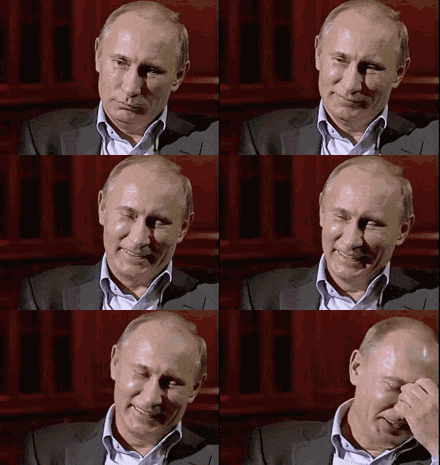
«First, I’ll meet with Putin, I’ll meet with Zelenskyy. They both have weaknesses and they both have strengths (...) And within 24 hours that war will be settled. It will be over. It will be absolutely over.»
Mr. Trump in a CNN town hall in 2023
«Putin is just laughing, not stopping the killing but increasing the killing»
EU’s foreign policy chief Kaja Kallas«Putin laughs at President Trump's peace efforts»
Polish Foreign Minister Radek Sikorski
Continuação de Os cortes no orçamento federal anunciados pelo Sr. Musk podem ser um bocadinho magalómanos

Por muito paradoxal que seja a acção do DOGE, ainda mais paradoxal é que, entre o pork barrel e o prolongamento das redução de taxas sobre o rendimento introduzidas no primeiro mandato de Donald Trump, do que está em discussão no Congresso podem resultar incrementos das despesas federais e redução dos impostos que acrescentarão à dívida biliões de dólares.
 |
| The Cost of BIG, BEAUTIFUL DEBT (fonte) |
Em resultado, várias agências reviram em baixa a classificação de crédito da dívida americana que perdeu o triple A pela primeira vez em décadas. É mais um exemplo notável das leis Merton de unintended consequences de que a administração MAGAlómana nos tem dado inúmeros exemplos.
Como corolário a lei de Merton, Elon Musk, o mentor do DOGE, saltou em andamento do comboio do MAGA com um post bombástico na sua rede X:
«I’m sorry, but I just can’t stand it anymore. This massive, outrageous, pork-filled Congressional spending bill is a disgusting abomination. Shame on those who voted for it: you know you did wrong. You know it.»
E assim terminou uma GREAT and BEAUTIFUL friendship.
Antes de olharmos para os cortes anunciados pelo Sr. Musk, recordemos uma estimativa feita em Setembro do ano passado sobre os impactos orçamentais no período 2025-34 das políticas anunciadas pelos candidatos de onde resultava que o défice total estimado para uma administração Trump seria o dobro do de uma administração Harris.
 |
| Fonte |
De volta ao Sr. Musk que perante o delírio dos magalómanos presentes no MAGA-comício no Madison Square Garden garantiu o ano passado que iria cortar um terço do orçamento federal anual de US$ 7 biliões, o equivalente a US$ 2,3 biliões (2.300.000.000.000).
Seis meses depois a propaganda do DOGE (Departamento de Eficiência Governamental) anuncia ter feito cortes de US$ 170 mil milhões ou 7,3% do anunciado, dos quais a parte mais bem documentada são os US$ 31,8 mil milhões de 10.248 cancelamentos e alterações de contratos dos quais o Financial Times só conseguiu confirmar cerca de 2/3. Ainda assim, há provas de avaliações inflacionadas, por exemplo considerando como corte da despesa contratos já terminados, e muitos dos cortes anunciados são pontuais e não recorrentes nos próximos anos e outros ameaçam paralisar o aparelho federal.

[Leia What has Elon Musk’s Doge actually achieved? para ter mais detalhes dos excessos magalómanos]
“All animals are equal, but some are more equal than others”?George Orwell's novel “Animal Farm,
 |
| Political Fact |
An old man suffering from extreme narcissistic personality disorder imagines himself to be the most powerful man in the world and the world watches the old man being humiliated in the locus of his alleged power live by a rude brat under the amused gaze of his father.
And no, the humiliation is not whether or not X said that Trump is not the president, as claimed by devotees who started reading lips and came to the ridiculous conclusion that X was saying he wanted to pee. Even if it was, it would have just been something said by a brat whose father was unable to raise him properly, which in itself is quite serious for a father who claims to be the master of the universe. The humiliation was how Musk completely disrespected the President, not that ridiculous guy sitting there, but the POTUS.

Gráfico 2: A acumulação de casos nos tribunais de imigração mais do que dobrou durante o mandato de Trump. As deportações em massa anunciadas por Trump aumentarão ainda mais o tempo médio de processamento que já é superior a 1.000 dias.
Gráfico 3: Os recursos da Customs and Border Protection são insuficientes e Trump prometeu aumentar 10.000 agentes neste mandato e dar a cada um bónus de retenção de US USD 10.000. Não se sabe se isso compatível com os planos do DOGE de Elon Musk que pretende cortar USD 2 triliões (escala curta ou 2 biliões na escala longa) da despesa federal.
Gráfico 4: As deportações caíram significativamente em relação a Obama que expulsou em média mais 22% do que Trump.
Gráfico 5: Os obstáculos para expulsar 11 milhões de imigrantes ilegais muitos deles com filhos nascidos nos EUA poderão criar uma confusão legal, logística e diplomático maior do que a do primeiro mandato que Trump não conseguiu resolver.
 |
| Reuters |
A fazer o lugar do CEO da Microsoft, o imigrante indiano Satya Nadellla, dando informações através dos mídia ao SEC Mark Toshiro Uyeda, neto de imigrantes japoneses que foram internados pelo governo americano durante a Segunda Guerra Mundial.
(...) begin with Mr Trump’s most dangerous idea: a 10-20% across-the-board tariff, accompanied by a 60% levy on all Chinese imports. This would undoubtedly batter Asia. America is the leading export destination for ASEAN countries, India and Japan, as well as the second-biggest destination for South Korea and Taiwan. asean’s trade intensity, measured as the ratio of trade to GDP, is twice the global average. Asian countries with ageing populations require external demand to grow.
A simulation of a full-blown tariff scenario conducted by Oxford Economics, a consultancy, finds that non-China Asia would be a net loser. In the long run American imports from the region would fall by 3% and exports to it by 8%. Demands for retaliation would grow, driven by the political prerogative to “not look like a wimp”, notes Jayant Menon of the ISEAS-Yusof Ishak Institute, which hosted the ASEAN get-together. Such tit-for-tat tariffs would ultimately amount to self-harm. Economic theory suggests that protection can be optimal (in narrow balance-of-trade terms) when countries enjoy outsized market power in the trade of a particular good—a condition that does not hold for most of Asia. Worse still, American military partners, including Australia, India and Japan, would be forced to choose between their economic and security interests.
These dangers are clear. Some Trump loyalists play down the chances of an all-out trade war, however, insisting that the threat of enormous universal tariffs is merely a negotiating tactic. Although a less dramatic ratcheting-up of the America-China trade conflict would be less devastating, it would still pose risks.
«First, I’ll meet with Putin, I’ll meet with Zelensky. They both have weaknesses and they both have strengths (...) And within 24 hours that war will be settled. It will be over. It will be absolutely over.»
«Vice-president Elect J. D. Vance once said that he doesn’t care what happens to Ukraine. We will soon find out whether the American people share his indifference, because if there is not soon a large new infusion of aid from the United States, Ukraine will likely lose the war within the next 12 to 18 months. Ukraine will not lose in a nice, negotiated way, with vital territories sacrificed but an independent Ukraine kept alive, sovereign, and protected by Western security guarantees. It faces instead a complete defeat, a loss of sovereignty, and full Russian control.
This poses an immediate problem for Donald Trump. He promised to settle the war quickly upon taking office, but now faces the hard reality that Vladimir Putin has no interest in a negotiated settlement that leaves Ukraine intact as a sovereign nation. Putin also sees an opportunity to strike a damaging blow at American global power. Trump must now choose between accepting a humiliating strategic defeat on the global stage and immediately redoubling American support for Ukraine while there’s still time. The choice he makes in the next few weeks will determine not only the fate of Ukraine but also the success of his presidency. (...)»
Trump Is Facing a Catastrophic Defeat in Ukraine, Robert Kagan in The Atlantic
Continued from (1), (2), (3), (4), (5), (6), (7), (8) and (9)
"Drill, baby, drill" is one of Mr. Trump's most popular mottos. With this colorful formula Mr. Trump designates his plans to increase gas and oil production that will allow him to increase exports and reduce the trade deficit and, in addition, the budget deficit. In normal politicians, what they say must be seen cum grano salis. What does Mr. What Trump says must be seen cum multum salis.
In the case of shale oil, the best wells are already being explored, so the increase in production will be carried out at increasing costs and will only be profitable if oil prices increase enough. On the other hand, as the largest economies are growing little or moderately, global demand is not expected to increase significantly, also because a transition to electric vehicles is underway.
Also increasing gas production faces some obstacles starting with the prices needed to justify new investments to increase production, prices that are not expected to increase enough because new operators such as Australia and Qatar are entering the market.
In conclusion, once again, Mr. Trump´s statements are like the news of Mark Twain's anticipated death - greatly exaggerated.
[Source: How much oil can Trump pump?]
(To be continued)The election of Mr. Trump will have consequences not only for the USA but for several other countries, starting with the European Union, which he had already clearly warned in his previous term regarding Defense and NATO: «No, I would not protect you…in fact, I would encourage [the Russians] to do whatever the hell they want. You got to pay. You got to pay your bills.» Today the consequences for the EU will be even heavier with the Franco-German engine broken politically and economically.
Also in terms of external trade, the EU will bear the consequences of its surplus in trade with the USA, which will be around USD 200 billion, of which around 40% relates to Germany, which will be the hardest hit country.
In addition to the EU, the countries most affected by the tariff increases promised by Mr. Trump will be China, Mexico, Vietnam, Canada and Japan, with surpluses in USD billions of almost 300, more than 150, about 100, about 80 and about 80, respectively. Regarding immigrant remittances, several countries could be affected, especially Mexico, whose emigrants are responsible for more than USD 50 billion in remittances.
In the 1930s, the American government increased the average tariff on imports by six percentage points, initiating protectionist reactions that significantly reduced foreign trade for all countries and prolonged the effects of the 1929 crisis until almost the end of World War II. Imagine the potential effects of the gigantic raises promised by Mr. Trump, which we hope will largely be show off.
Education is one of the areas in which Mr. Trump are contradictory. He promised to dismantle the Department of Education, according to him full of «radicals, zealots, and Marxists» - apart from the usual exaggeration he has a point, and return power to the State. On the other hand, he says he wants to use executive power to force schools to adopt his cultural agenda.
Strangely, Mr. Trump and Mr. Sanders, a fierce left-wing Democrat, both agree to set a maximum of 10% for interest on credit card payments. They are both wrong because with the rewards generally associated with use, the cards are a vehicle for transferring an estimated value of USD 15 billion from those who do not benefit from the rewards, generally the poorest, to those who use them, generally the wealthiest.
(To be continued)

